Why Repeatable Certificate Workflows Help Annual and Multi-Event Programs
Many institutions and conference organizers do not conduct just a single event. Universities, professional associations, training institutes, and research organizations often run recurring programs such as annual conferences, semester-based courses, departmental symposiums, workshops, certification programs, and training cycles. In such environments, issuing certificates is not a one-time activity but a recurring operational task.
When certificate management is handled manually for each event, teams often end up rebuilding the same processes repeatedly—creating new templates, redefining access mechanisms, and re-establishing distribution methods. Over time, this repetition creates unnecessary administrative effort and increases the likelihood of inconsistencies. This is where repeatable certificate workflows become extremely valuable.
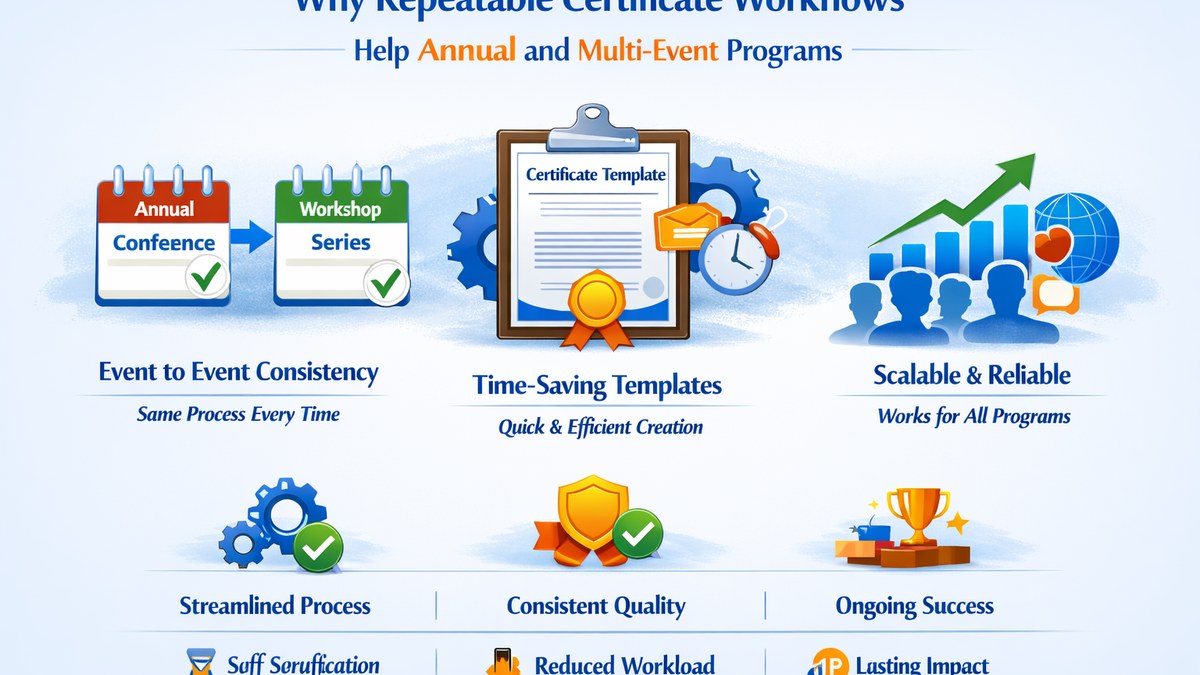
A repeatable certificate workflow allows institutions to establish structured processes that can be reused across multiple events. Instead of rebuilding certificate operations every time, organizations can rely on standardized templates, predefined distribution models, and consistent access mechanisms. This approach helps teams operate more efficiently while maintaining a professional and consistent credentialing experience.
Understanding Repeatable Certificate Workflows
A repeatable certificate workflow refers to a structured process that can be reused across multiple events or programs without needing to redesign the entire certificate system each time. The workflow typically includes the certificate template, participant data structure, generation process, access control mechanisms, and delivery method.
Once this workflow is designed and tested, it can be reused for future events with minimal adjustments. For example, an institution may simply update the event name, date, or participant list while keeping the underlying certificate structure and distribution process the same.
This repeatability transforms certificate issuance from a repetitive manual activity into a scalable operational process that can support multiple events efficiently.
Why Repeatability Is Important
In organizations that conduct frequent events, certificate management can quickly become an operational burden if handled independently for each program. Teams may spend unnecessary time recreating templates, redefining access workflows, and troubleshooting the same issues repeatedly.
By implementing repeatable workflows, institutions avoid these inefficiencies. Teams can rely on established processes that have already been tested and refined. This improves reliability while reducing the amount of preparation required for each event cycle.
Repeatability also reduces confusion among organizers and participants. When the certificate process remains consistent across events, both administrators and recipients know what to expect.
Main Benefits of Repeatable Certificate Workflows
1. Lower Preparation Effort
One of the most immediate advantages of repeatable workflows is the reduction in preparation work. Instead of creating certificate templates, layouts, and delivery processes from scratch for each event, teams can reuse structures that have already proven effective.
This allows organizers to focus on the event itself rather than spending time rebuilding administrative systems. Over multiple events, the time savings can be substantial.
2. Better Consistency Across Events
Consistency is an important aspect of institutional professionalism. When certificates vary significantly between events—different layouts, inconsistent branding, or unclear structures—it can weaken the perceived credibility of the credential.
Repeatable workflows ensure that certificates maintain a consistent design, structure, and delivery method across multiple programs. This strengthens institutional identity and ensures that all recipients receive credentials that follow the same professional standards.
3. Faster Certificate Delivery
In many events, participants expect to receive their certificates soon after the program concludes. If organizers must rebuild certificate processes for each event, delays can occur.
Reusable workflows allow teams to generate and release certificates quickly because the system is already configured. Once participant data is available, certificates can often be produced and distributed within a much shorter timeframe.
4. Easier Team Handover
Events are often managed by rotating teams or different departments within an institution. When certificate processes depend heavily on specific individuals, knowledge transfer becomes difficult when staff changes occur.
Repeatable workflows help address this issue by providing a clear operational framework that new team members can follow. Instead of learning an entirely new system, they simply continue working within an established structure.
5. Reduced Risk of Operational Errors
When certificate workflows are recreated repeatedly, there is a higher chance of mistakes such as formatting inconsistencies, incorrect data mapping, or delivery issues. Standardized workflows reduce these risks by relying on processes that have already been validated.
This stability improves the reliability of certificate issuance across events.
Supporting Institutional Scalability
As institutions expand their programs, the number of events requiring certificates often increases. A university may conduct dozens of academic workshops each semester, while professional organizations may run multiple conferences and training sessions throughout the year.
Without repeatable workflows, managing certificates for such a large number of events becomes difficult. Administrative teams may struggle to maintain consistency and efficiency.
Repeatable systems allow organizations to scale their operations without significantly increasing administrative complexity. Once a reliable workflow is established, it can support a wide range of programs across departments and event types.
Why This Matters for Academic and Professional Institutions
Academic institutions and professional organizations often operate across multiple departments, each conducting their own events. In such environments, a standardized certificate workflow helps ensure that credentials across the institution maintain a consistent level of quality and professionalism.
This consistency is particularly important when certificates are used for academic recognition, professional development, or career advancement. A clear and repeatable system ensures that all credentials follow the same institutional standards.
Repeatable workflows also reduce dependency on individual coordinators. Instead of relying on personal experience or ad-hoc processes, certificate management becomes an institutional capability that can be maintained over time.
Building Effective Repeatable Certificate Workflows
Creating a repeatable workflow involves designing processes that remain flexible enough to adapt to different events while maintaining core consistency. Organizations typically begin by establishing a standardized certificate template, defining participant data structures, and implementing consistent access and distribution methods.
Once these elements are in place, they can be reused across events with only minor adjustments. Over time, institutions often refine these workflows further to improve efficiency and user experience.
Modern digital certificate platforms often support this approach by allowing administrators to save templates, automate certificate generation, and reuse delivery workflows for multiple events.
Conclusion
Repeatable certificate workflows play an important role in helping institutions manage recurring events efficiently. By transforming certificate management into a reusable process, organizations can reduce administrative effort, maintain consistency across programs, and deliver credentials more quickly.
For universities, conference organizers, and training providers that run multiple events throughout the year, repeatable workflows turn certificate issuance from a recurring operational burden into a scalable institutional capability.
Frequently Asked Questions
What is a repeatable certificate workflow?
A repeatable certificate workflow is a standardized process for generating and distributing certificates that can be reused across multiple events without rebuilding the system each time.
Why are repeatable workflows useful for recurring events?
They reduce preparation effort, improve consistency, and allow teams to deliver certificates faster after each event.
Do repeatable workflows help large institutions?
Yes. Institutions that conduct many events benefit greatly from standardized certificate processes because they make operations more scalable and easier to manage.
Can repeatable workflows improve participant experience?
Yes. Consistent certificate processes help participants receive credentials quickly and through familiar access workflows, improving overall satisfaction.