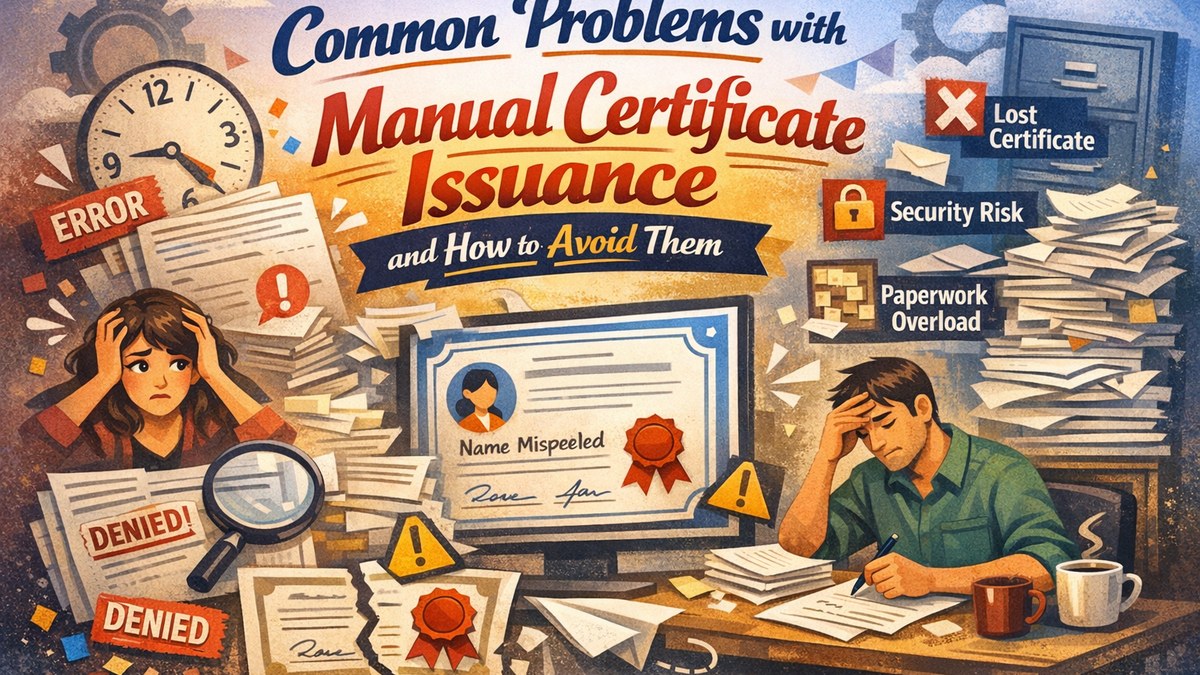
Common Problems with Manual Certificate Issuance and How to Avoid Them
Many organizations begin certificate issuance with manual methods. At first, the process may seem manageable: prepare a template, enter names, export files, and send them one by one. But as the number of recipients increases, manual certificate handling becomes harder to control.
What starts as a simple task can quickly turn into a recurring operational burden. Errors increase, delays grow, and support requests multiply. This is why more institutions, event organizers, and training teams are moving away from manual certificate workflows.
Why Manual Processes Break Down
Manual certificate issuance depends heavily on repeated human effort. Names are copied from spreadsheets, titles are adjusted manually, files are rechecked, and individual corrections are often handled case by case. This creates inconsistency and increases the risk of avoidable mistakes.
Common Problems in Manual Certificate Workflows
1. Spelling and Data Errors
Incorrect names, titles, institutions, and roles are among the most frequent certificate complaints. Even a small spelling mistake can reduce the value of the credential for the recipient.
2. Delayed Delivery
When certificates are prepared manually, distribution often takes longer than expected. This can reduce participant satisfaction and create unnecessary follow-up communication.
3. Inconsistent Design Output
Different batches, template versions, or formatting adjustments may create inconsistent certificate presentation.
4. High Reissue Burden
Years after an event, recipients may still ask for a duplicate certificate. If records are not properly organized, staff may struggle to locate old versions.
5. Difficult Verification
Manually issued certificates often lack structured verification support, making authenticity checks more difficult.
6. Repetitive Administrative Effort
Teams end up spending time on the same types of tasks repeatedly: correcting names, resending attachments, re-exporting PDFs, and answering access-related queries.
How Digital Workflows Solve These Issues
A structured digital certificate system helps eliminate many of these pain points. Instead of depending on repeated manual handling, the system can pull recipient information from stored records, generate certificates consistently, support secure retrieval, and enable verification mechanisms.
This does not only improve speed. It also improves reliability, record retention, and overall recipient confidence.
Why This Matters at Scale
The larger the event or institution, the more visible manual workflow problems become. A process that works for 20 certificates may fail badly for 500 or 5,000. As organizations grow, they need systems that reduce dependence on repetitive editing and manual tracking.
Conclusion
Manual certificate issuance may appear simple in the beginning, but it becomes increasingly inefficient as the number of recipients grows. By moving to digital certificate workflows, organizations can reduce errors, improve delivery speed, simplify reissues, and build a more dependable credential system.