How Institutions Can Automate Certificate Delivery and Reduce Manual Work
Certificate issuance is an important part of academic events, training programs, faculty development initiatives, student activities, and professional conferences. But when delivery is handled manually, it often becomes slow, repetitive, and error-prone. This is why more institutions are now moving toward automated certificate delivery.
Automation does not simply make certificate release faster. It also improves consistency, reduces operational strain, and creates a better experience for both administrators and recipients.
What Automated Certificate Delivery Means
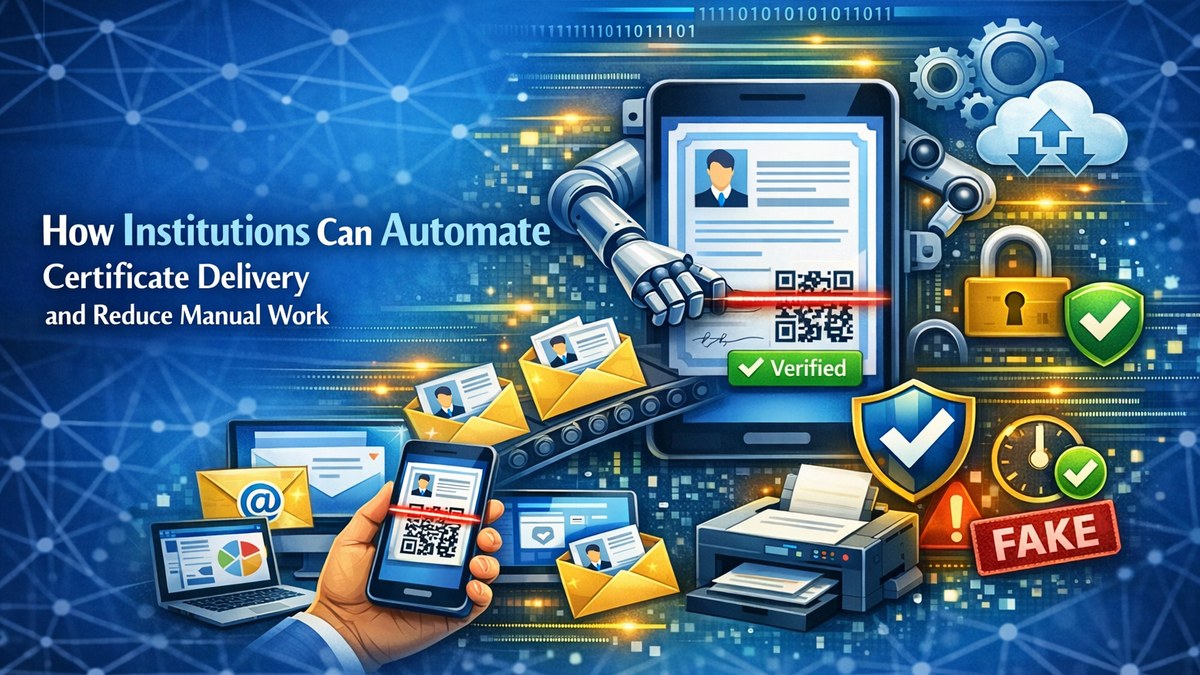
Automated certificate delivery means using a structured digital workflow to generate, publish, and make certificates available without relying on repeated manual effort for every recipient. Instead of editing files one by one and sending them individually, the institution uses participant data and system-driven processes to manage delivery at scale.
Why Institutions Need Automation
Many institutions handle multiple events, departments, programs, and participant categories throughout the year. Manual certificate handling may work temporarily for very small groups, but it becomes difficult as volume increases. Staff members end up correcting names, regenerating files, resending attachments, and responding to repeated requests for missing or duplicate certificates.
Automation helps remove these bottlenecks and makes certificate release more dependable.
Key Benefits of Automated Delivery
1. Faster Certificate Release
Certificates can be made available much more quickly after event completion or result finalization.
2. Better Accuracy
When certificate data comes from stored participant records, the risk of manual typing mistakes is reduced.
3. Lower Administrative Burden
Teams spend less time repeating the same tasks and more time managing exceptions only when necessary.
4. Better Scalability
Automation supports large events and repeated programs far more effectively than manual workflows.
5. Improved Recipient Experience
Participants receive a smoother and more professional certificate retrieval process.
What a Good Automated Workflow Includes
- Structured participant or recipient data
- Reusable certificate templates
- Controlled generation workflows
- Secure access or retrieval methods
- Verification support
- Consistent branding across certificates
Why This Matters for Educational and Event Institutions
Institutions are judged not only by the quality of the event or program, but also by how professionally they handle post-event processes. Timely and accurate certificate delivery strengthens credibility and reduces dissatisfaction among participants.
Conclusion
Automating certificate delivery helps institutions reduce manual work, improve consistency, and operate more efficiently at scale. For organizations issuing credentials regularly, automation is not just a convenience. It is an operational upgrade that improves both internal workflows and recipient trust.